

 In August I spent several days at a Benedictine community in Vermont. I was struck by how boldly “other” their monastic life is, and how it challenges our assumptions about what matters for change in this world. Yet I have to admit that after carefully watching their patient rhythms, I wondered, “Do they really think this is going to change the world? What is a Benedictine theory of change anyway?”
These days, similar to for-profit businesses, those in ministry and non-profit worlds are under increased pressure to show immediate and visible results through a viable “theory of change.” As one NGO explains,
“In its simplest form a theory of change can be stated as, ‘We believe that by doing X (action) it will achieve Y (progress towards peace, reducing poverty, etc.).’ For example… ‘If we generate jobs for unemployed youth, they will be less available to be recruited to violence.’”
With most theories of change comes this assumption: Deep long-term change in the world can be determined by human control. Such as the assumption in this time of political and social media warfare that change can be determined by more and more words, said with more and more outrage.
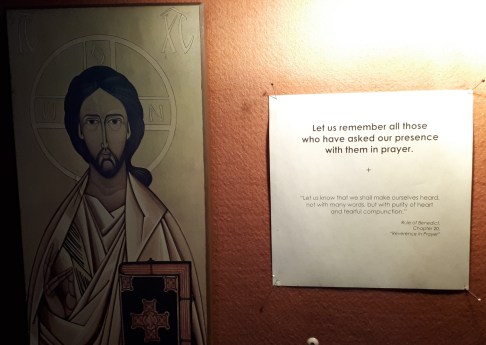
Which is why I was jolted by a very different vision of change I saw one morning at the monastery, as I happened to walk through the area where the brothers prepare before the multiple times of daily worship. On a bulletin board was an icon of Christ along with the words below at the beginning of the poem I wrote later that day. Amid the seemingly innocuous rhythms of their life, it would be a grave mistake to underestimate a Benedictine understanding of how to “make ourselves heard” in response to the problems which have a noisy stranglehold on this world.
A Benedictine Theory of Change
“Let us know
that we shall make ourselves heard,
not with many words,
but with purity of heart
and tears of compunction.”
Rule of Benedict, Chapter 20, written 516 A.D.
Dawn at the monastery:
Why do the pillows and blankets sit abandoned so soon?
All the brothers are in a circle in the chapel,
Singing in praise.
Midmorning:
Why do the guitars sit still on the wall?
All the brothers have their hands in the soil,
Tending the gardens.
Midday:
Why does the wheelbarrow sit still by the garden?
All the brothers sit in the refectory in silence,
Eating and listening to a reading.
Afternoon:
Why is the stillness broken?
All the brothers are surrounded by worshippers in the barn,
Prophesying about overcoming walls and borders.
Evening:
Why do the bibles sit still back in the barn?
All the brothers are walking the grounds,
Conversing and laughing with their guests.
Night:
Why is everything, everywhere, all silenced now?
All the brothers lie on their pillows sleeping,
Trusting that Divine love still, always, tills the world.
Where, for each of them this day, and how,
Was that grand battle of the centuries waged?
With wrath, envy, pride, principalities and powers?
Weston Priory, Vermont, August 2019
Related Posts:
 Chris Rice
Leave a reply to Chris Rice Cancel reply