


“There is no reconciliation without memory because there is no hope for a peaceful tomorrow which does not seriously engage both the pain of the past and the call to forgive” — from 10 Theses : Recovering Reconciliation as the Mission of God in Reconciling All Things
I’ll never forget our family’s 2005 visit to the Apartheid Museum in Johannesburg, South Africa. All of us including the children were deeply moved, and it sparked important conversations about healing the pain of the past.
There is no museum in the U.S. to mark the “original sin” of slavery. Indeed, the truly prophetic nature of South Africa’s attempt at healing has been three-fold: a rigorous wrestling with the past; a commitment to a new future of “black and white together” which requires mercy (see Tutu’s No Future Without Forgiveness, in contrast to Robert Mugabe’s approach in Zimbabwe next door); and a serious attempt to pursue this communally, as a nation, in a way never attempted in the U.S.

So the news I received today from a friend in Richmond, Virginia is significant: the city’s Slave Trail Commission has unveiled a vision for a $100 million to $150 million slavery museum at the historical site of Richmond’s slave market, where 300,000 Africans and their descendents were torn from their families and sold down the river to Southern plantations. A column in today’s Richmond Times-Dispatch says, “Richmond, which has stopped running and hiding from a fundamental facet of its history, is poised to give birth to a slavery museum…”
Richmond? The capital of the Confederacy during the Civil War? Things like this don’t just “happen.”

Rob Corcoran of Richmond, the friend who shared the slavery museum news with me, is national director of Initiatives for Change and probably the most important racial healer in America you’ve never heard of. A native of England, Rob and his wife Susan dedicated their lives to Richmond some years ago and, with many others, without great fanfare, have done the slow, patient, gritty work of building trust in their city—which is, by the way, the only way to build trust in a city.
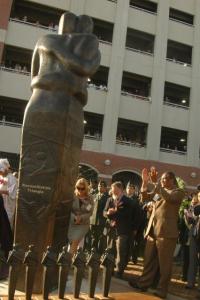
Hope in the Cities, along with other community partners, has been active in helping to move this slave museum forward for many years, as well as the Reconciliation Triangle. When I visited Rob last spring he took me to the Reconciliation Statue that was dedicated in 2007, also near Richmond’s former slave market. Later we visited the extraordinary folks at Richmond Hill, an interracial community of Christians located in an old monastery overlooking the city. Their full-time work is praying for Richmond, spiritual renewal, and collaborative efforts across racial lines to serve urban youth.
For those looking for fresh approaches to taking their cities to a new place of healing, there may be no better place to learn from than Richmond. Hope in the Cities’ Healing History initiative includes a pioneering Walk Through History. I was privileged to be part of the first Richmond walk in 1993. I will never forget what one African-American leader said when we came to the Confederate memorial. “I have always viewed this statue with anger. Today is the first time I have seen that it was built out of grief.”
These are the kind of remarkable “new people” being formed in Richmond.
Also see:
The DNA of a Trustbuilder by Rob Corcoran
 Chris Rice
Leave a reply to Tom Smith Cancel reply