

“Never, ‘for the sake of peace and quiet,’ deny your own experience or convictions”
Dag Hammarskjöld, in Markings
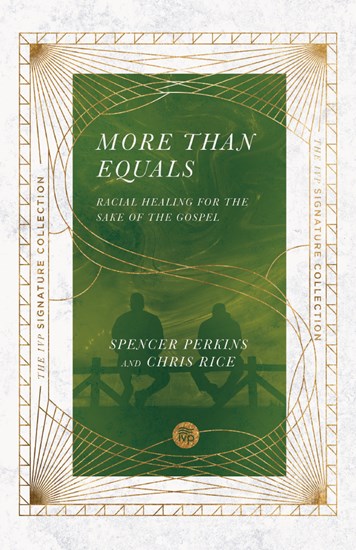
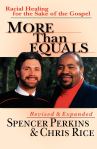
It gives me joy to share that More Than Equals: Racial Healing for the Sake of the Gospel, the book Spencer Perkins and I wrote together, was just republished as one of 27 books chosen for the InterVarsity Press Signature Collection Series. The publisher writes, “In celebration of our 75th anniversary, InterVarsity Press is releasing special editions of select iconic and bestselling books from throughout our history.” This special edition has a new cover and a new introduction where I connect “More Than Equals” to today’s new racial time (see book information and how to order at IVP and Amazon). I am filled with wonder to see our witness take on new life.
When our book came out in 1993, U.S. evangelical publishers rarely if ever did books on race. IVP took a risk, and Spencer and I were simply happy to be published. There was no guarantee that “More Than Equals” would be widely read. In fact, when we approached one major white Christian leader to write an advance endorsement, he declined, and his associate sent a scathing critique. Spencer and I were devastated. I can imagine him saying, “White people aren’t gonna read this book.”
This fragile beginning, and the special occasion of the new edition, provoke a few reflections.
First, I love author Madeleine L’Engle’s remark that the pursuer of creativity should “expect revelation.” While the writer lives to move, inspire, and entertain readers, we cannot do this by readers dictating the writer’s convictions, intuition, and innovation. In his classic book “Markings,” Dag Hammarskjöld, the second head of the United Nations, writes, “He broke fresh ground—because, and only because, he had the courage to go ahead without asking whether others were following or even understood.” What gave Spencer and I the fire in the belly to write was that our ideas were drawn from a communal experience of an unusual authenticity, the deep racial change we saw in that community and others across the nation, and the conviction that race was a matter of ultimate importance — in spite of most white Christians denying that. As we put it in More Than Equals, “It is not so much that God is using the church to heal the race problem, but more that God is using race to heal the church.” One life-changing experience Spencer wrote about shortly before his untimely death in 1998 was added later as a new chapter to the book’s second edition. But when Spencer first shared that message from a conference platform, it was hardly popular and many in the audience would have said, “Please don’t publish that.” Yet even today Spencer’s words have the ring of prophecy.
Second, while InterVarsity Press took a risk on More Than Equals, IVP is now a leader in the field of Christian publishing on race and ethnicity. Institutions matter, and institutions with the courage to pioneer “without asking whether others were following or even understood” are critical to planting seeds of deep change in this world. Today the wider organization InterVarsity Christian Fellowship is arguably the most authentically multi-ethnic ministry in the U.S. This in spite of much opposition over the years, staying true to what Eugene Peterson once called “a long obedience in the same direction.”
Third, does More Than Equals still matter? Let me just say this. As I write in the new introduction, “The lessons we offer are drawn from a shared life in Mississippi between blacks and whites that was likely one of the most dynamic and long-lasting interracial communities in American church history. For over four decades, in the heart of the American South, as many as 150 people in Voice of Calvary Church and Ministries shared daily life amid racial differences that continually threatened to undo us. Over time, we became a new people, altered at our very core.” I continue, “What sought to tear us apart? What held us together? If hope requires sacrifice, what does sacrifice look like? Our successes, failures, struggles and methods are worth examining by new generations seeking a church that embodies and pursues justice for all.” I would like to believe that those decades at Voice of Calvary were a kind of revelation which still speaks to a new racial time.
Fourth, More Than Equals may have been a word for its time, but as this recent article in Christianity Today points out, words on the quest for racial healing were needed, and have been given, to surpass what Spencer and I had to say nearly thirty years ago (I think of IVP authors such as Dominique Gilliard, Esau McCaulley, and Brenda Salter-McNeil). What theologian Karl Barth once wrote comes to mind, that we “can do no more than question after the better, and never forget that we are succeeded by other, later” people, and that the person “who is faithful in [their] task will hope that these other, later [people] may think and say better and more profoundly what we were endeavoring to think and say.”
Finally, my thoughts turn to Spencer’s legacy and the enormous loss of him leaving this earth too suddenly and too soon, at age 44. He was a superb writer and communicator, with a profound ability to speak across cultures and divides with both truth and empathy; his listeners felt simultaneously cut to the heart (Acts 2:37) and deeply loved. His platform was growing: two new books underway, named a contributing editor at Christianity Today magazine, appearing on a major radio show with his father John Perkins. He was constantly curious and learning, pursuing new connections to Hispanic and Asian Americans. Only 16, he came face-to-face in a jail with his bloodied father the morning after John Perkins was nearly beaten to death by white police officers. He suffered the humiliation of integrating an all-white school. And he was one who was courageously willing, with all of that included, to receive and speak a word beyond himself, a word about what is required of us to walk over the rubble of the divides which Jesus has torn down (Ephesians 2:14). I have no doubt Spencer would be saying some of the most important things there are to say today in our new post-George Floyd racial time. He was the most faithful mixture of prophetic truth and pastoral love I have ever encountered on this earth. What a word we received in his very life. If More Than Equals can simply keep that witness alive, I am grateful.
 Chris Rice
Leave a comment