

Unlike our many years in inner-city Jackson, Mississippi sharing life and church across economic and racial lines, my wife Donna and I have found ourselves on different ground these last 10 years, living on “the other side of the tracks” in a predominantly affluent and white congregation in Durham. Many people ask why. Here’s the short answer—God can call you to the strange ground of being white in a black community at one time in your life, and to the equally strange ground where we are now at another time. I regularly find myself longing for that Mississippi-style setting, but I believe it’s true, God’s unique call to be with unique companions at unique times.
Yet from this side of the tracks, crossing divides for the sake of the gospel is surely a difficult task in a very different way—the primary challenge being that the privileged rarely see or feel the gaps and divides, or what is at stake in engaging them.
Eventually I became frustrated with leading bible and book studies about all this. It felt like we were having a monologue within our church’s walls. And if I learned anything in Mississippi it’s how much is at stake in not only what the Bible says but who we study it with and where.
Then, a breakthrough of imagination.
In 2005 our family participated in a two-week Duke Divinity School Pilgrimage of Pain and Hope to Uganda and Rwanda. Toward the end of the journey I told Donna, “You know, we need a pilgrimage like this in Durham, at home.” We discussed how there are places in Durham that from our side of the tracks might as well be in Africa—just as strange, just as uncomfortable, just as much another world, just as full of suffering and strangers and fellow believers and “angels unawares,” just as significant for our learning what it means to be Christian.
Three years later, in 2008, I led Blacknall Presbyterian Church’s first pilgrimage into Durham. Last weekend was our third annual “Lenten Pilgrimage into the Heart of Durham.”
Once again I saw how our nearest ground is often our most difficult ground. Many pilgrims have confessed they’d rather go overseas than into unknown worlds of Durham. Once again I saw how pilgrimage is a profound journey of interrupting the way we view reality. And for the privileged, this interruption often has to be intentional. Once again we prepared by discussing the difference between being a tourist (being entertained), giving aid (being the solution), and being a pilgrim (the willingness to be drawn into a new community). Once again, within the season of Lent, we envisioned the journey as one with Jesus to Gethsemane and the cross–a pathway to learn to pray with Jesus “not my will but Thy will be done.”
And once again I experienced the powerful truth: there are some things God can only teach us through relocation—taking our bodies and our Bibles across divides. I am always amazed how powerfully God speaks to hearts and minds through the profound simplicity of the weekend’s movements.
Movement one: After a brief worship service Friday night at church, at “home,” our 18 pilgrims prayed that strange ground might be transformed into holy ground.
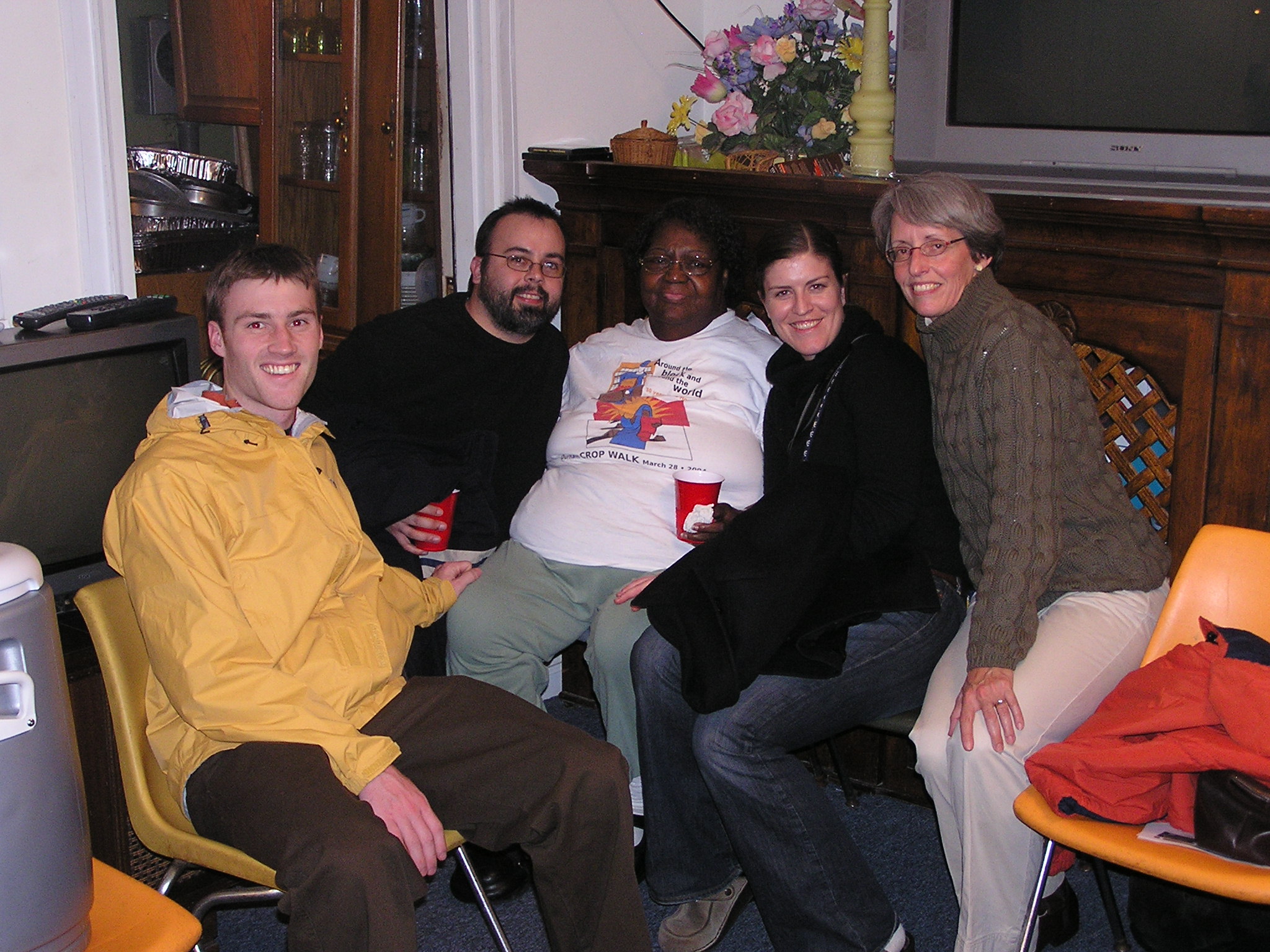
Movement two: We carpooled to the home of Ann Atwater for barbeque and story-telling. Ann is a Durham icon, an African-American apostle of reconciliation in our city. Right there in her living room she told of her unlikely road to friendship with Klan activist C.P. Ellis in the 1970’s and their common work for the poor of our city. We sang her favorite hymn together, “Just As I Am,” we prayed for her, she prayed for us. The first year of the pilgrimage I learned that many pilgrims were in a black person’s home for the first time.

Movement three: Early Saturday morning we car-pooled to what police call the “Bulls Eye” of east Durham, a neighborhood of gifts yet also where most of our homicides happen (24 in 2009). In a church basement we sang “Spirit of the Living God, Fall Afresh on Me,” then heard stories from Marcia Owen—the director of the Religious Coalition for a Non-Violent Durham—and three friends who spent significant time in prison and are on pathways to deep transformation. I wll never forget the first pilgrimage to this basement, meeting a mother whose teenage daughter kept a precious photo album, full of obituaries of friends who had been killed.
Movement four: Three hours with a congregation of recent Latino immigrants—home-made taco lunch, stories of their difficult challenges, worship in Spanish. Later, one of our pilgrims told me he will never look at the immigration question the same—before the weekend it was clear-cut, now it is murky, after hearing the stories.
Movement five: Duke Gardens, a time of absorbing the gifts of the journey thus far through quiet walking, prayer, and reflection (and, for me, napping), then back to Blacknall to share our reflections .
Movement six: A few blocks away across what I called “the Broad Street divide” to the Walltown neighborhood—a very different neighborhood racially and economically. We shared dinner with African-American neighbors at St. John’s Baptist Church, whose 100-year history mirrors our church. We spent the night with host families, then re-gathered Sunday morning for breakfast and the St. John’s worship service.
The entire weekend—all these different worlds, gifts, and places of pain and hope—are within 10 minutes of one another. We had said we were going onto strange ground not to be tourists or humanitarians but pilgrims. Not to paint a house but to hear stories of pain and hope. Not to solve race or poverty but to learn what it means to be Christian and this church here in this city, in order to expand our “we” toward God’s new community.
At church tomorrow we begin three Sundays of reflecting on the journey and to see how God speaks to us through it. I’ll let you know what happens.
About the Author: Chris Rice is co-director of the Center for Reconciliation at Duke Divinity School. He is author of Reconciling All Things, Grace Matters, and More Than Equals. He writes regularly at the blog Reconcilers.
Related Reconcilers Posts:
Last 5 posts on the Reconcilers Blog:
- 2010 Duke Summer Reconciliation Institute: A Gift of Nourishing for Christian Leaders
- The Nitty-Gritty of Healing Our Histories: Three Recommended Readings
- The Belhar Confession: Holding Together Jesus and Justice
- Hymn to an Insane-Loving God: In Memory of Spencer Perkins
- Voices From My East Africa Journey
 Chris Rice
Leave a comment